Author name: vaid.pr1111

AI, Blog, Featured, HR & Work

Best AI Recruitment Tools for HR Teams: Complete Guide for 2026

If you work in HR or talent acquisition you know the feeling. A job posting goes live. Suddenly you have over 150 applications in your inbox. The perfect candidate is in there somewhere. Finding them takes hours. AI recruitment tools are designed to solve this problem. These tools have come a way since simple resume keyword matching. Now they can find candidates conduct video interviews, score applicants and even write outreach messages that sound human. In this guide we’ll look at the AI recruitment tools available now. We’ll compare them discuss their costs and help you choose the one for your team. Whether you’re a startup or a large HR department you’ll find something that fits your needs. What are the best AI recruiting tools for HR in 2026? If you only have a time here is what you need to know: Greenhouse is the best choice for hiring when you need something that does everything. Juicebox and Pin are great for finding people to hire using intelligence. HireVue is the best for doing a lot of video interviews. Workable is a choice for companies that are getting bigger because it has a lot of features and is easy to use.. Manatal is a good option for small teams that do not have a lot of money and are just starting to use artificial intelligence to hire people. The right tool, for you depends on what’s holding you back the most. Finding the right people looking at applications doing interviews or scheduling meetings. So keep reading to find the tool that solves the Greenhouse problem or the Juicebox and Pin problem or the HireVue problem or the Workable problem or the Manatal problem that you are having. Table of Contents What Are AI Recruitment Tools, and Why Do They Matter in 2026? What Should HR Teams Look For in an AI Recruiting Tool? Which AI Recruitment Tools Are Best for Sourcing Candidates? Which Tools Are Best for Screening and Matching? Which Tools Are Best for AI-Powered Interviews? Real-World Examples Key Statistics on AI in Recruitment Comparison Table Pros & Cons of Using AI Recruitment Tools FAQ Section Key Takeaways Conclusion What Are AI Recruitment Tools, and Why Do They Matter in 2026? AI recruitment tools use machine learning and natural language processing to handle parts of hiring. These tools help with finding candidates checking resumes setting up interviews and analyzing responses. For example of a recruiter reading 200 resumes an AI tool can rank them by how well they fit the job in just a few minutes. It can then flag the 20 resumes and explain why they are ranked high. The reason AI recruitment tools matter more now is that many companies are hiring people.. The recruiting teams are not getting bigger. Many recruiters now manage around 20 jobs at a time. This is hard to handle without help. AI tools save recruiters time so they can talk to people of entering data. Recruiters can focus on what they do talking to people. AI recruitment tools give them hours in their week. What Should HR Teams Look For in an AI Recruiting Tool? Before choosing a tool it’s helpful to understand what makes a great platform different from an one. Does it work well with your ATS? A recruiting tool that doesn’t connect to your tracking system actually creates more work. Look for connections with platforms like Greenhouse, Lever, Workday or SmartRecruiters. Can it explain how it scores candidates? If an AI tool says a candidate is a match you should see why. This is important for fairness and following the law. Does it help reduce bias or make it worse? Good AI recruiting tools focus on skills and experience not things like age or where you live. Ask the people selling the tool how they make sure it’s fair. Is the price okay for your team? Some tools charge per person others per job and others charge a fee. A tool that works for a startup might not work for a big company. How hard is it to learn? Some platforms are easy to start using while others take weeks to get started. Be honest, about how time your team has. Which AI Recruitment Tools Are Best for Sourcing Candidates? Finding the right people is usually the part for teams that are hiring especially when they are looking for people who are not really looking for a new job. Juicebox is really good at this. It allows people who are hiring to search through a list of over 800 million people using simple language that anyone can understand, instead of using complicated search terms. This is especially helpful for teams that spend a lot of time looking for and talking to potential candidates but bigger teams might still need to use another tool to manage everything. Pin is also a player now. The people who made Interseller, which was bought by Greenhouse also made Pin. It helps with finding people sending them messages and scheduling meetings in one place. It says that it gets a lot of responses from the messages it sends automatically and it has a version that people can try before they decide to pay for it. Findem is another choice, especially for people who work for agencies that help companies find new employees. It is good, at finding people that other search tools might miss because it uses intelligence to understand what the words really mean instead of just looking for certain keywords.   Which Tools Are Best for Screening and Matching? When you have people who want to work for you the next big problem is finding out who is really good enough to talk to. Workable is very helpful with this. It has a tool that uses computers to look at the people who want to work for you. It gives them a score. This score shows how well they match what you are looking for in a worker. It can
AI, Blog, Featured

Can AI Tools Really Replace an Entire Small Business Team in 2026? What Every Business Owner Needs to Know

If you have a business you might have thought this before: “Can I run my business with just AI tools and a smaller team?” It’s not an idea. AI chatbots can write your marketing copy. AI assistants can answer customer emails. AI tools can help with bookkeeping and scheduling appointments. It seems like one person could do the work of people. The truth is different from what people say. AI is great at doing things. It is not good at running a business. There’s a difference, between those two things. Understanding this difference can save you from making a mistake. This blog post explains what AI can and can’t replace. It shares what real business owners are experiencing with AI. It also helps you think about AI as a business owner without getting caught up in the hype or being too afraid to try it. Quick Answer For This Blog Question No computers with intelligence cannot fully take over a small business team in 2026. They can take over some jobs, especially ones that are repetitive and follow a set process. Most small businesses that do are using AI to need fewer people in areas like writing content answering simple customer questions, scheduling appointments and keeping track of finances. They still need people for making decisions building relationships coming up with plans and anything that needs a high level of trust or creativity. Think of AI as a coworker that needs to be managed not someone who can do every job on their own. AI tools are good at doing tasks. They are not a replacement, for a whole team of people. Table of Contents What AI Can Actually Do for a Small Business Today The Roles AI Is Genuinely Replacing (Question-Based) The Roles AI Still Can’t Touch (Question-Based) Real Examples From Small Businesses What the Numbers Say — 2026 Statistics AI Team vs Human Team: A Side-by-Side Comparison Pros and Cons of Going AI-Heavy FAQ Section Key Takeaways Conclusion What AI Can Actually Do for a Small Business Today Let us start with what’s real. In 2026 small business owners have access to Artificial Intelligence tools that can do a lot of things for them such as: Write blog posts, product descriptions, social media captions and email newsletters Answer customer questions instantly 24 hours a day 7 days a week through chatbots Book appointments send reminders and manage calendars Categorize expenses, generate invoices and flag unusual transactions Analyze sales data and suggest what to restock or promote Generate designs, logos and marketing images Screen resumes and draft job descriptions That is a very long list and it includes work that people used to get paid to do. This is exactly why many small business owners are asking if they really need a team of people working for them anymore. Look at that list again: almost every single thing, on it is something that Artificial Intelligence tools can do but it is not something that involves people talking to each other or making important decisions. Artificial Intelligence tools are doing tasks not building relationships or making decisions. This difference is very important. It is where the idea that Artificial Intelligence tools can replace everyone starts to not make sense. The Roles AI Is Genuinely Replacing (Question-Based) Is artificial intelligence replacing content writers and marketers? Partially the answer is yes. Artificial intelligence can do a job with first drafts and social media posts. It can also handle marketing work. This means that many small businesses do not need a time junior writer anymore. One person can use intelligence tools to do the work that used to require two or three people. Artificial intelligence is used for marketing and creating content more than anything by small businesses today. Is intelligence replacing customer service representatives? For things like frequently asked questions and order status the answer is yes. Artificial intelligence chatbots can handle these things for businesses that use artificial intelligence. This has changed a lot in the couple of years. However if a customer has a problem or wants to complain about something they usually talk to a human. Is intelligence replacing bookkeepers? The answer is partially yes. Artificial intelligence accounting tools can be used with platforms like QuickBooks or Xero. These tools can sort transactions point out mistakes and make reports automatically.. Most business owners still have a human accountant or bookkeeper to help with taxes making sure they follow the rules and signing off on things. This is because making mistakes with these things can have consequences. Is intelligence replacing schedulers and administrative assistants? The answer is yes largely. Artificial intelligence scheduling tools can handle calendar coordination, reminders and basic communication, with clients. These tools are becoming very popular with people who work alone or in very small teams. The Roles AI Still Can’t Touch (Question-Based) Can AI build genuine customer relationships? Not really. Customers can tell the difference between a canned response and a person who actually cares whether they had a good experience. Trust, loyalty, and word-of-mouth referrals — the things that keep a small business alive — still come from human connection. Can AI make strategic business decisions? No, not on its own. AI can analyze data and suggest options, but deciding whether to expand into a new market, hire a key employee, take on debt, or pivot your business model requires judgment, risk tolerance, and context that AI doesn’t have. It doesn’t understand your specific goals, your local market quirks, or your gut instincts built from experience. Can AI handle skilled, hands-on work? No. If your business involves plumbing, electrical work, carpentry, healthcare, cooking, or anything physical, AI isn’t showing up to do the job. It’s worth noting that adoption in trades and construction remains among the lowest of any small business sector, largely because the actual work can’t be automated by software. Can AI take legal or financial responsibility? No. If something goes wrong — a bad contract, a compliance violation, a tax filing

AI, Blog, Featured

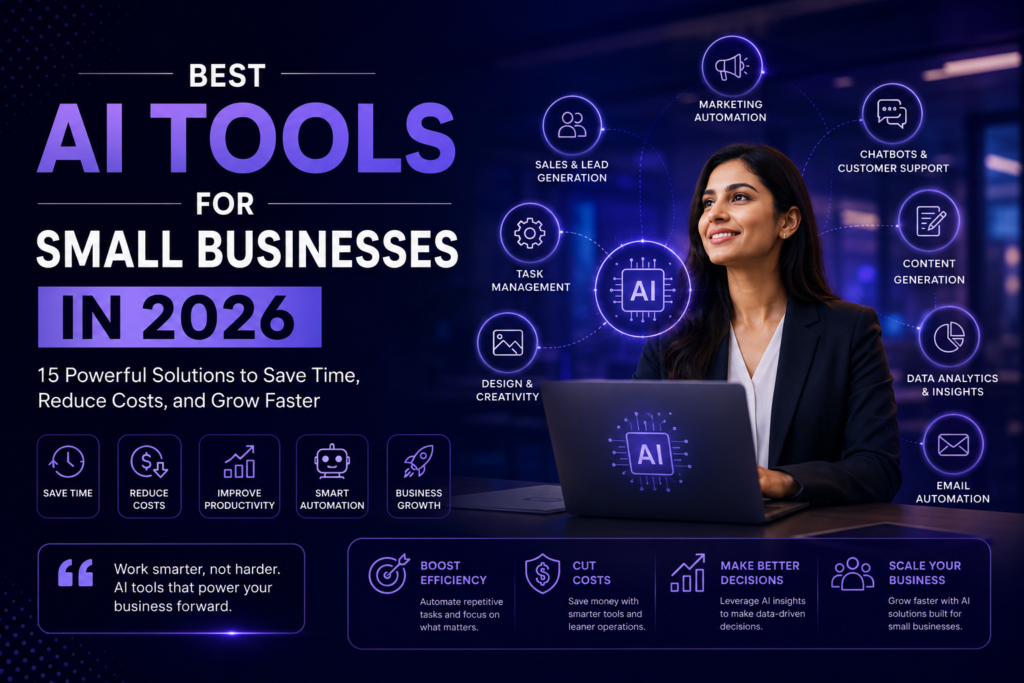
Best AI Tools for Small Businesses in 2026: 15 Powerful Solutions to Save Time, Reduce Costs, and Grow Faster

Running a business in 2026 can be really tough. It is like running a marathon. Someone just keeps adding more miles to the race. You have to do a lot of jobs. You are the founder of the business the marketer, the bookkeeper and the customer support team. You have to do all these jobs before you even have lunch. The good thing is that artificial intelligence has become very affordable. It is, like an employee that you can hire. Artificial intelligence does not get sick so it does not need to take days off. It also does not need a lot of training so you can start using these tools quickly usually within one hour. A lot of business owners are using artificial intelligence now. They are not just trying it out they are actually using it to help them with their work. Artificial intelligence is being used more and more in workflows. Here are 15 artificial intelligence tools that are worth looking at in 2026. These tools are grouped by what they can do to help your small business. There are also examples of how you can use these tools so you can see how they can fit into your business. What Are the Best All-Purpose AI Assistants for Everyday Work? Think of these as your generalist hires, the ones you hand anything to. 1. ChatGPT. It’s like a multi-tool for businesses. It helps with drafting emails coming up with ideas summarizing documents and answering questions on almost any topic. For example a freelance consultant uses it to turn a voice note into a polished client proposal in just ten minutes. ChatGPT is really good at helping with these tasks. 2. Claude. This is Anthropics assistant. Many people use it alongside ChatGPT for research writing and tasks that need a lot of reasoning. Small teams use it for things like writing contracts in language or summarizing customer feedback. Claude is great at these kinds of tasks. 3. Microsoft 365 Copilot. This tool brings AI into Word, Excel, PowerPoint and Outlook. It has a layer that learns about you, your job and your company. For instance a bookkeeping firm that already uses Excel a lot can use Copilot to turn raw expense data into a summary thats ready for clients. They can do this without leaving the spreadsheet. Microsoft 365 Copilot is really helpful for tasks, like this. Which AI Tools Help You Create Content Without Hiring a Writer? 1. Jasper is a tool that helps with marketing content. It learns how your brand sounds. Writes first drafts of blog posts ad copy, social captions and email campaigns. For example a small skincare company can give Jasper their product information. Get a whole month of Instagram captions all at once. 2. Canva has something called Magic Studio. It has tools like Magic Write for writing Magic Design for making layouts and Magic Media for making pictures and videos from text. This means people who are not designers can make posts, flyers or ads from a simple idea. For example a café owner can type “I want an cozy flyer for a weekend brunch special” and have a design ready to print in just a few minutes. 3. Grammarly Business does more than just check for spelling mistakes. It also helps keep your companys style consistent and can even write emails and documents from bullet points, inside Gmail, Outlook and Slack. This makes it really easy to get work done. What’s the Best AI for Managing Customers and Sales? 1. HubSpot is really easy to use. Its Breeze AI engine does a lot of things. It helps with predicting which leads are likely to buy something. It also makes deal summaries.. It has a sales coach that listens to recorded calls and gives tips on how to do better. The good thing is that you can use a lot of these features for free or with the Starter plan. For example a small sales team with two people can use the CRM to keep track of which leads have actually replied to them. 2. Missive is a tool that puts all your messages in one place. This means you can see emails, texts, WhatsApp messages Instagram messages, Facebook messages and live chat messages all together. This makes it easy for a team to work together to reply to messages without getting confused. For example a small online shop can use Missive to make sure they do not miss any messages from customers on media. All the messages come to one place so they can see everything. 3. Gladly is a tool. It is designed to help teams talk to customers in a way. It does this by keeping track of everything that has happened with each customer. This means that when a team member replies to a customer they can make it sound like they really care. This is useful for businesses that want to build relationships, with their customers. They want to make sure their customers feel like they are talking to a person, not just a robot. . Which AI Tools Save Time on Admin and Internal Knowledge? 1. Notion AI is a cool tool that is part of every page. It can do a lot of things like generate text summarize what was said in a meeting turn bullet points into documents and answer questions about the things you have stored in your workspace. For example you can take a meeting transcript paste it in and ask Notion AI to find the important things that need to be done who is in charge of them and when they are due. 2. Fireflies is a meeting tool that helps with taking notes. It joins your calls and takes notes for you then it gives you a summary of what was said that you can search through later. This is really helpful for teams because it means nobody has to spend their time writing down everything that is

Featured

How to Use Public Relations for Career Growth

In today’s fast-moving and highly competitive world, building a successful career is not just about skills and qualifications; it’s also about how you present yourself to the world. This is where public relations plays a powerful role. Often misunderstood as something only big companies use, public relations is actually a valuable tool for individuals who want to grow professionally, build credibility, and create meaningful opportunities. Let’s explore how you can use public relations strategically for your career growth. 1. Build Your Personal Brand with Public Relations Your personal brand is how people perceive you: your skills, personality, and professional identity. Public relations helps you shape this perception intentionally. Instead of waiting for others to define you, you can actively communicate your strengths, achievements, and values. Start by identifying what you want to be known for. Are you a creative designer, a strategic thinker, or a problem-solver? Once you’re clear, align your online presence: LinkedIn, portfolio, or even Instagram; with that message. Share your work, insights, and achievements regularly. Public relations is all about storytelling, and your career is your story. 2. Use Content to Position Yourself as an Expert One of the most effective ways to use public relations for career growth is through content creation. Writing blogs, sharing industry insights, or posting educational content helps you establish authority in your field. For example, if you’re in marketing, you can write about trends, case studies, or your experiences. This not only showcases your knowledge but also builds trust among your audience. Over time, people start seeing you as someone who understands the industry well. Consistency is key here. You don’t need to post daily, but you should aim to stay visible and relevant. 3. Networking with a PR Mindset Networking is not just about exchanging contacts; it’s about building relationships. Public relations teaches you how to communicate effectively, listen actively, and create genuine connections. Attend events, join online communities, and engage with professionals in your industry. When you interact, focus on adding value rather than just asking for help. A simple comment on someone’s post, sharing useful information, or appreciating their work can go a long way. Strong relationships often open doors to opportunities that are not publicly advertised. 4. Manage Your Online Reputation In the digital age, your online presence is your first impression. Public relations helps you manage and maintain a positive image across platforms. Regularly check what shows up when someone searches your name. Ensure your profiles are updated, professional, and aligned with your goals. Avoid posting content that could harm your credibility. If you’ve made mistakes in the past, don’t panic. Public relations is also about recovery. Focus on building positive content and gradually shifting the narrative. 5. Leverage Media and Visibility Opportunities Public relations is closely linked to media exposure. Getting featured in blogs, podcasts, or interviews can significantly boost your credibility. You don’t have to wait for big opportunities. Start small; contribute guest posts, collaborate with creators, or participate in webinars. Each appearance adds to your visibility and strengthens your professional image. Think of it as building a portfolio of trust. The more people see your name associated with valuable content, the more they recognize your expertise. 6. Communicate Your Achievements Effectively Many talented individuals struggle because they don’t talk about their achievements. Public relations teaches you how to highlight your work without sounding arrogant. Instead of saying, “I did this,” focus on the impact: “This project increased engagement by 40%” or “Helped improve team efficiency.” This approach makes your contributions more meaningful and measurable. Whether it’s your resume, LinkedIn profile, or interviews, clear and confident communication can make a huge difference. 7. Stay Consistent and Authentic One of the biggest mistakes people make is trying to be someone they’re not. Public relations is not about creating a fake image; it’s about presenting your authentic self in the best possible way. Be consistent in your messaging, tone, and values. People trust authenticity more than perfection. When your actions match your words, your credibility grows naturally.   Growing your career with public relations is something you need to keep working on; it’s not just a one-time thing. You have to be clear about what you want, be consistent, and be willing to put yourself out there. When you build a strong personal brand, make content that’s actually useful, take care of your reputation, and network with people in a smart way, you can open doors to new opportunities and move your career forward faster. It’s all about being proactive and taking control of your own professional path. Public relations is really about getting your message across to the right people, so they understand what you’re all about and why it’s important. When you do it well, it can completely change how others perceive you and can even help you go further in your career. It’s not just about promoting yourself but also about building relationships and making sure your message resonates with the people who matter. By doing so, you can open up new opportunities and take your career to the next level.

Career & Personal Branding

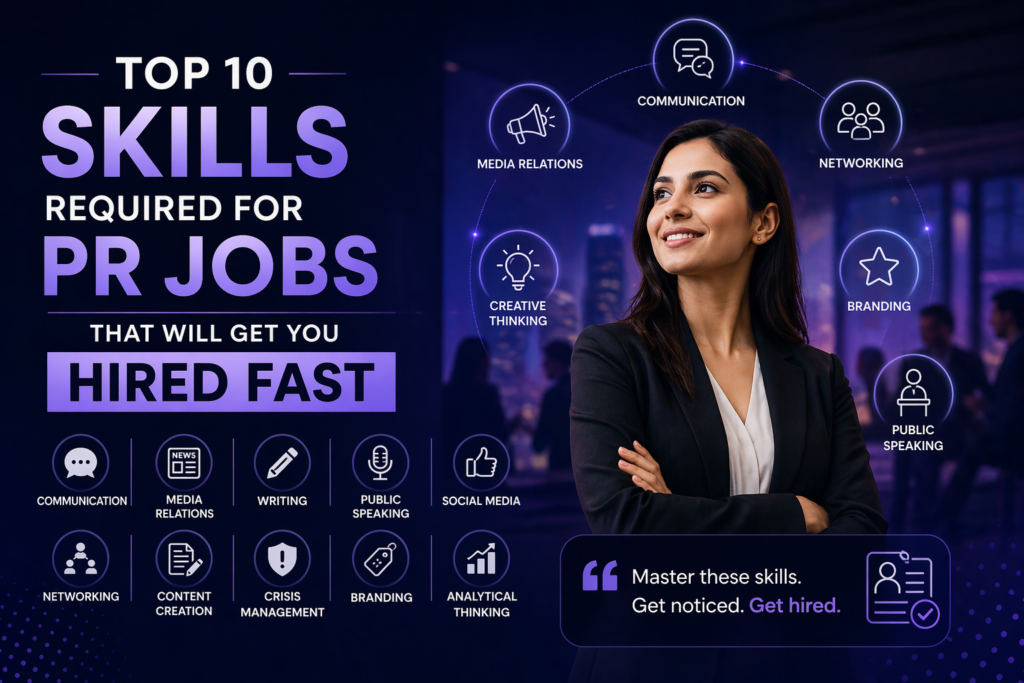
Top 10 Skills Required for PR Jobs That Will Get You Hired Fast

Why PR Skills Matter More Than Ever Public Relations (PR) is not just about promoting a brand, it’s about building trust, managing reputation, and creating meaningful connections with the audience. In today’s competitive job market, simply having a degree is not enough. Recruiters are actively searching for candidates who understand the real skills required for PR jobs and can apply them practically. Whether you’re a fresher, an HR professional transitioning into PR, or someone building their own agency, mastering the right skills can significantly speed up your hiring journey. The good news? Most of these skills can be learned and improved with practice. Let’s dive into the Top 10 Skills Required for PR Jobs That Will Get You Hired Fast, explained in detail so you can actually start working on them. Top 10 Skills Required for PR Jobs That Will Get You Hired Fast 1. Strong Communication Skills Communication is the backbone of PR. You will constantly interact with clients, journalists, influencers, and internal teams. This means you must be able to express ideas clearly, confidently, and professionally. It’s not just about speaking well; it’s also about listening. Understanding client needs, media expectations, and audience reactions is equally important. Strong communication skills ensure that your message is delivered correctly without confusion, which is why it is one of the most critical skills required for PR jobs. 2. Writing & Content Creation Writing is a daily task in PR. From press releases and email pitches to social media captions and blogs, content creation is everywhere. Good writing in PR means the following: Being clear and concise Avoiding grammatical errors Writing in a tone that suits the brand You don’t need to be a novelist, but you must know how to write content that grabs attention and delivers value. Practicing daily writing can significantly improve these essential skills required for PR jobs. 3. Media Relations PR professionals act as a bridge between brands and the media. Building strong relationships with journalists, editors, and media houses can help you secure coverage for your clients. This skill involves: Knowing how to pitch stories Understanding what journalists are looking for Maintaining long-term professional relationships Good media relations can give your client free publicity and credibility, making it one of the most powerful skills required for PR jobs. 4. Social Media Management Modern PR goes beyond traditional media. Social media platforms are now essential tools for brand communication. You should know how to: Create engaging posts Respond to audience comments Manage brand reputation online Analyze performance metrics Being active and strategic on platforms like Instagram and LinkedIn is now a must-have among the skills required for PR jobs. 5. Crisis Management Every brand faces difficult situations such as negative reviews, public backlash, or unexpected controversies. A PR professional must stay calm and handle these situations smartly. Crisis management includes: Responding quickly and professionally Controlling damage to brand reputation Communicating the right message at the right time Companies highly value this skill because it directly impacts their public image, making it one of the most important skills required for PR jobs. 6. Networking Skills PR is a relationship-driven industry. The more people you know, the more opportunities you create. Networking doesn’t just mean collecting contacts; it means building genuine connections. This includes: Attending industry events Connecting with professionals on LinkedIn Engaging with influencers and media people Strong networking can open doors to job opportunities, collaborations, and media coverage, making it a key part of the skills required for PR jobs. 7. Creativity & Storytelling PR is not just about sharing information; it’s about telling stories that people remember. Creativity helps you present a brand in a unique and engaging way. For example: Turning a simple product launch into a compelling story, Creating campaigns that emotionally connect with the audience Creative storytelling helps brands stand out in a crowded market and is one of the most exciting skills required for PR jobs. 8. Research & Analytical Skills A successful PR strategy is based on data and research. You need to understand your audience, competitors, and industry trends. This skill includes: Market research Competitor analysis Measuring campaign success When you make decisions based on data rather than assumptions, your PR strategies become more effective. That’s why research is among the most practical skills required for PR jobs. 9. Time Management PR professionals often handle multiple tasks at once: client meetings, content creation, media follow-ups, and campaign planning. Without proper time management: Deadlines can be missed Work quality can suffer Stress levels increase Using tools like calendars and task managers can help you stay organized. Efficient time management ensures smooth workflow and is a must-have among the skills required for PR jobs. 10. Adaptability & Learning Attitude The PR industry is constantly evolving, especially with digital trends changing rapidly. What works today may not work tomorrow. Being adaptable means: Learning new tools and platforms Staying updated with trends Accepting feedback and improving A learning attitude shows employers that you are future-ready, making it one of the most underrated yet essential skills required for PR jobs.

Career & Personal Branding

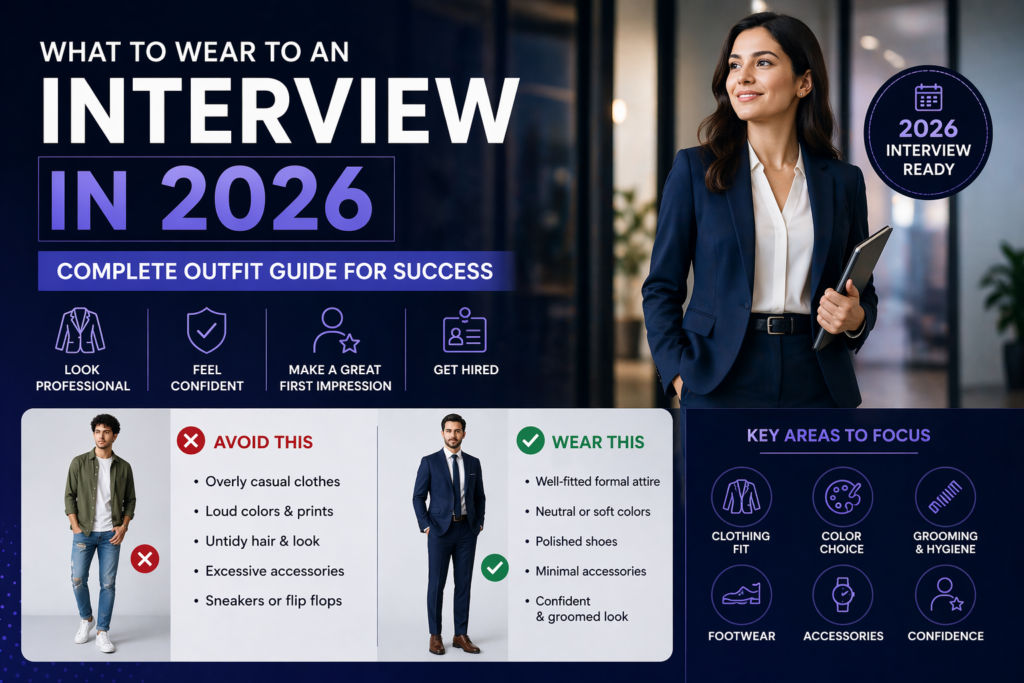
What to Wear to an Interview in 2026 (Complete Outfit Guide for Success)

First Impressions Start with Your Outfit When it comes to interviews, your appearance speaks before you even say a word. The way you present yourself creates an immediate impression, which can influence how the rest of the conversation goes. This is why understanding what to wear to an interview is so important. Many candidates spend hours preparing answers and researching the company, but often overlook their outfit. The truth is, dressing appropriately not only shows professionalism but also boosts your confidence. When you feel good in what you’re wearing, it reflects in your body language and communication. If you’ve ever felt confused about what to wear to an interview, you’re not alone. The good news is that with a few simple guidelines, you can choose an outfit that helps you make a strong and lasting impression. What to Wear to an Interview Deciding what to wear to an interview depends on several factors, such as the company culture, job role, and industry. However, some basic rules apply to almost every situation. 1. Understand the Company Culture: Before choosing your outfit, take time to research the company. Different workplaces have different dress codes, and knowing this will help you decide what to wear to an interview more accurately. For example, corporate offices usually expect formal attire such as suits or blazers. On the other hand, startups and creative industries may allow smart casual outfits. If you’re unsure, it’s always better to dress slightly more formal than required. 2. Choose Formal or Smart Casual Attire: A safe approach when deciding what to wear to an interview is to go with formal or smart casual clothing. For women: A formal shirt or blouse paired with trousers or a knee-length skirt A blazer for a polished look Closed-toe shoes For men: A formal shirt with well-fitted trousers A blazer or suit for a professional touch Clean, polished formal shoes This kind of outfit works well for most interviews and helps you look confident and prepared. 3. Stick to Neutral Colors: Color plays an important role in how you are perceived. When choosing what to wear to an interview, stick to neutral and subtle colors like black, navy blue, white, grey, or beige. These shades give a clean and professional appearance and ensure that the interviewer focuses on your skills rather than your outfit. Bright or flashy colors can sometimes be distracting, so it’s best to keep things simple. 4. Focus on Grooming and Details: Your overall appearance goes beyond just clothes. Grooming is an essential part of deciding what to wear to an interview. Make sure: Your clothes are clean and well-ironed Your hair is neat and tidy Your nails are clean You avoid strong perfumes Small details can make a big difference and show that you pay attention to how you present yourself. 5. Prioritize Comfort and Fit: No matter how stylish your outfit is, if it’s uncomfortable, it can affect your confidence. While deciding what to wear to an interview, make sure your clothes fit well and allow you to sit, walk, and move comfortably. Avoid clothes that are too tight, too loose, or something you’re not used to wearing. The goal is to feel confident and at ease throughout the interview. 6. Avoid Common Dressing Mistakes: While understanding what to wear to an interview, it’s equally important to know what to avoid. Try not to wear: Casual outfits like ripped jeans or graphic t-shirts Overly bright or flashy clothing Wrinkled or unclean clothes Heavy makeup or strong fragrances Dressing too casually can make you seem unprepared, while overdressing excessively can make you feel out of place. Balance is key.

Career & Personal Branding

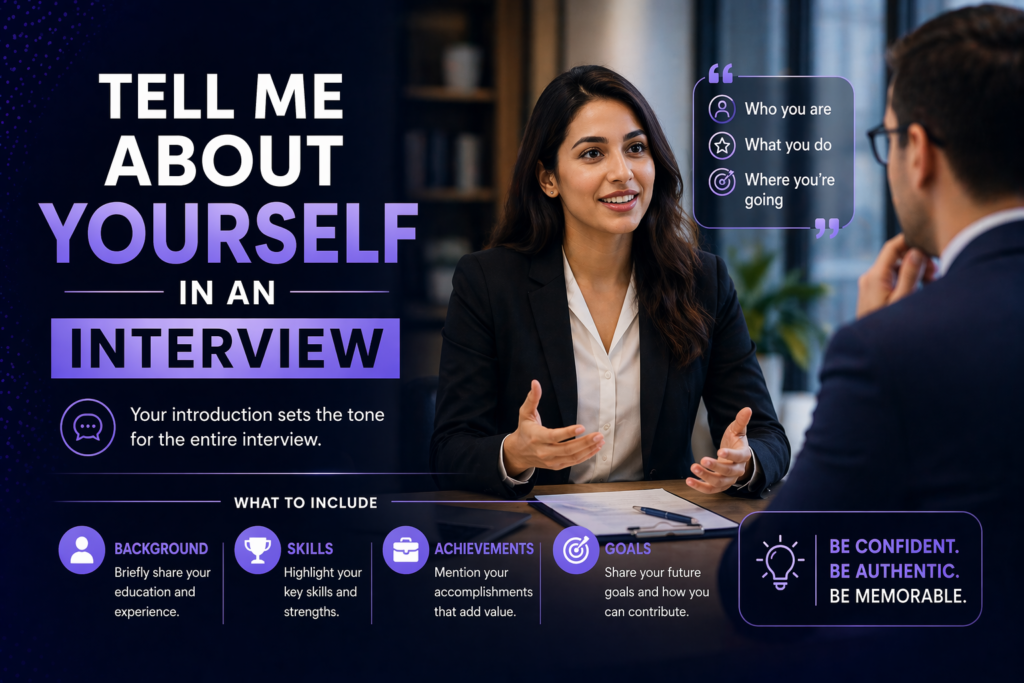
Tell Me About Yourself In An Interview

Introduction: “Tell Me About Yourself” One of the most common yet tricky questions candidates face is “Tell me about yourself in an interview.” It may sound simple, but this question often decides the first impression you create on the interviewer. Many candidates either say too much or struggle to say anything meaningful. The key is to give a clear, structured, and confident answer that highlights your strengths and aligns with the job role. In this guide, you’ll learn exactly how to answer “Tell me about yourself in an interview” with the right structure, examples, and expert tips. Why Do Interviewers Ask “Tell Me About Yourself”? When interviewers ask “Tell me about yourself in an interview,” they are not looking for your life story. Instead, they are trying to evaluate a few important things. First, they want to assess your communication skills. Your ability to present yourself clearly matters a lot in any role. Second, they want a quick summary of your background. This helps them understand your experience beyond what’s written in your resume. Third, they are checking how relevant you are for the position. A strong answer connects your skills and experience directly to the job. Lastly, they want to see your confidence level. The way you start your interview often sets the tone for the rest of the conversation. How to Structure Your Answer? The best way to answer “Tell me about yourself in an interview” is by using a simple and effective structure: 1. Present (Current Role or Situation): Start with what you are currently doing. Example: “I’m currently working as an HR executive with experience in recruitment and employee coordination.” 2. Past (Experience or Education): Briefly explain your background and how you got here. Example: “I started my career as a trainee coordinator, where I developed strong communication and organizational skills.” 3. Future (Career Goals): End by connecting your goals with the company. Example: “I’m now looking for an opportunity where I can grow in talent acquisition and contribute to a dynamic organization.” Using this structure ensures your answer is clear, professional, and impactful. Sample Answers for Different Candidates Fresher “I recently completed my graduation in BBA. During my studies, I developed an interest in HR and gained practical exposure through internships. I am eager to start my career where I can apply my skills and grow professionally.” Experienced Candidate “I have over 3 years of experience in HR, specializing in recruitment and onboarding. In my current role, I manage end-to-end hiring processes. I’m now looking for a challenging role where I can contribute strategically and grow further.” Career Switcher “I began my career in sales, where I developed strong communication and negotiation skills. Over time, I discovered my interest in HR and completed relevant certifications. I’m now looking to transition into a full-time HR role.” Common Mistakes to Avoid While answering “Tell me about yourself” in an interview, avoid these mistakes: Giving too much personal information Repeating your resume word for word Speaking without structure Taking too long to answer Showing lack of confidence. Avoiding these mistakes can make your answer more professional and impressive. Pro Tips to Impress the Interviewer To stand out when answering “Tell me about yourself in an interview,” follow these expert tips: Customize your answer for each job Keep your answer concise (1–2 minutes) Use simple and clear language Practice before the interview Focus on achievements and skills Maintain confidence and eye contact. A well-prepared answer can instantly boost your chances of success. Frequently Asked Questions:

Scroll to Top